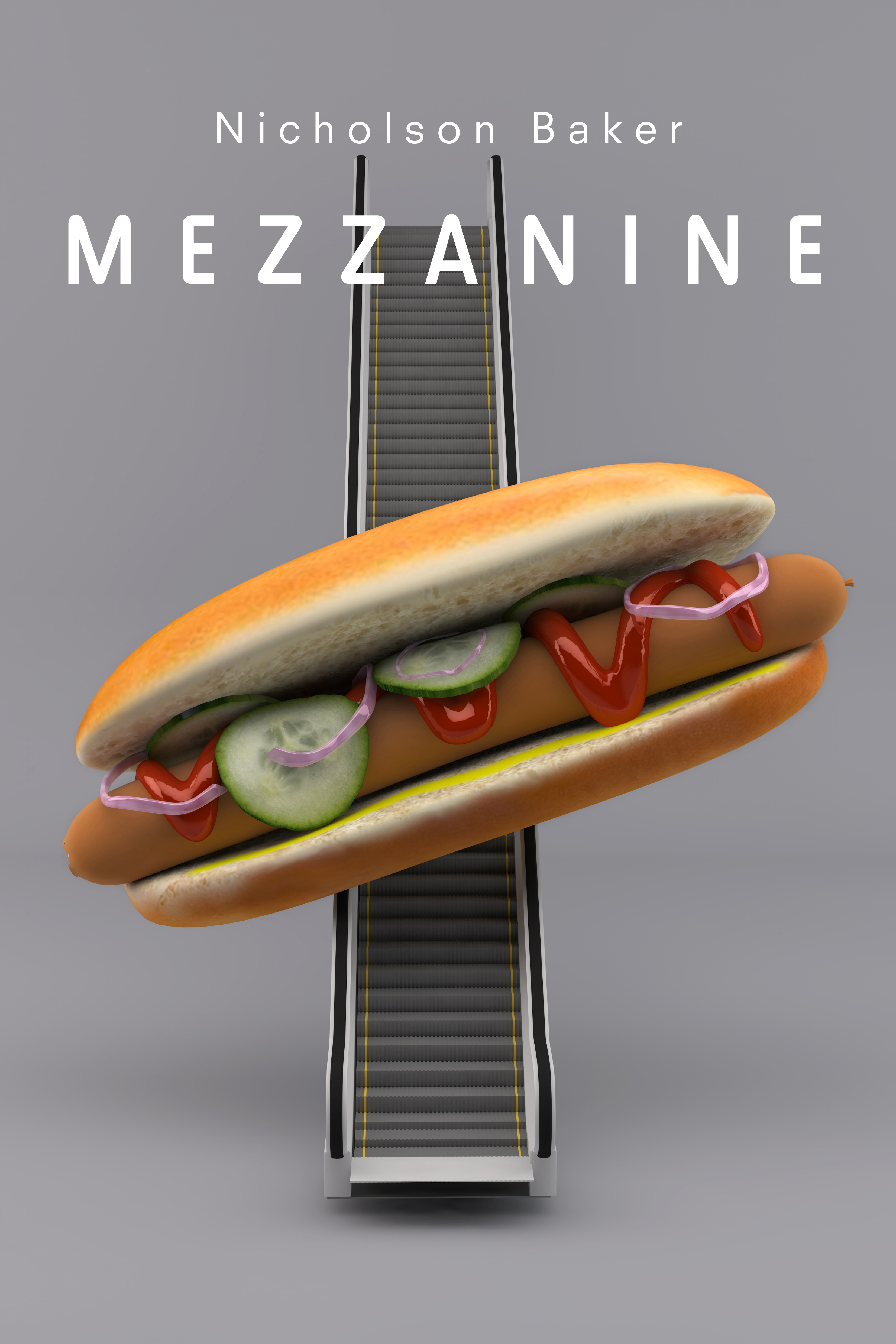
Caption: I find the covers' surrealistic vibe coincides with the novel's tangents. Source
The Mezzanine by Nicholson Baker, at its core, is a densely packed recontextualization of a multitude of insignificant trifles. The book, narrated by Howie, a corporate businessman whose life is defined by his in-depth analyses of ordinary objects.[1] What I'm here to talk about is memory in The Mezzanine. I find it quite impossible, the fact that he's able to retain such small and insignificant details, so it only begs the question: how reliable is his narration?
Outside it was noontime, nootime! Fifteen healthy, coltish, slender trees grew out of the brick plaza a short way into the blue sky in front of my building, each casting an arragement of potato chip-shaped shadows over its circular cast-iron trunk collar. [...] The rear of a truck with quilted metal sides was packed with sandwiches, spigots, Drake's Cakes, and cans in ice, its owner making change from the monetary calliope on his belt[.] (pg 105)
This quote illustrates the scene in excruciating detail, following his exit from the workplace. Describing the assortment of delectables lounging on the back of a truck is an unbelievable feat. No matter how eidetic his memory may be, and with how far in the future the book is written, it's truly profound that he's retained so much information.
I tried to call up some sample memories of shoe-tying to determine whether one shoe tended to come untied more often than another. What I found was that I did not retain a single specific engram of tying a shoe, or a pair of shoes, that dated from any later than when I was four or five years old, the age at which I had first learned the skill. Over twenty years of empirical data were lost forever, a complete blank.
This is a book about his extraordinary sense of observation. His fascination with the insignificant. Howie could name the exact date on which is coming-of-age occurred, and recalling "pulsating amoebas that absorbed excess stomach acid in Rolaids' great dripping-faucet commercial," and relating them to the pattern on his father's ties (pg 27). Yet he found absolutely nothing remotely interesting about tying his shoelaces? Having had the chance to observe and know his character very intimately, he had to have gleaned some hyper-specific conclusion from the event. So can we trust his sense of memory? How can the audience be sure any of the narrative is true, but simply an invention of his imagination? How could anyone have such a clear and unfaltering memory?
My reading of this whole situation is that these aren't necessarily observations from this specific escalator ride, but instead a whole lifetime's worth of rabbit holes projected onto one short 20-second interval. This is Howie's life work. His narration could just be a means to convey himself to the audience. His enlightened future-self taking his entire life up to that point, and simplifying it into a single escalator ride.
P.S. Apologies if there's any funky layout issues; Blogger's not cooperating.
Hi Mattox! This is such an interesting take. I also agree that Howie may be exaggerating intentionally at times or misremembering moments which could mean he's unreliable. But it also begs the question of even if he is, does the books core meaning still stand? Or does it mean less now that Howie added things to the story. For example, that one should de-familiarize themselves with the everyday item, like a shoelace in the moment and for it to truly work, did Howie need to document every single thought exactly for it to teach the reader? I don't have an answer but I thought it was really interesting to think about! Great work.
ReplyDeleteHey Mattox, great blog! As I was reading the book I also found myself wondering how Howie managed to recall all of these super specific details. Does he memorize every single word of every conversation he's every had? I would think not (but honestly I wouldn't put it past him), though all of his stories seem quite believable. I think that the overall meaning of the book still stands, whether or not he embellished his stories or not.
ReplyDeleteI really never thought about how reliable Howie's narrative was as I just assumed that because of the level of detail he was able to put on paper, he must have lived those exact actions. I think your blog has a really valid point though as even the most detail-oriented people have ordinary aspects of their life which they forget simply because of the mundaneness of it all. I think this blog was really well written and nice job on your vocab, I have never heard the word eidetic before.
ReplyDeleteI enjoyed you touching on the fact the book was written by Howie in the future. It reminded me of something I forgot about from our class discussions. I was also a fan of you adding a footnote. It made your blog feel more mezzanine-esque. Overall good blog!
ReplyDeleteHey Mattox! Talking about how reliable first person narratives are in books is one of my favorite things to talk about, and I love how you add the part about the narrative being a reflection on the escalator ride by a future Howie, which really puts the level of detail he's able to pack into a few seconds into perspective. I really like your take that this is Howie's way of expressing himself and his life, stuffing everything he can into a short time frame so we get that sense of who he is.
ReplyDeleteKudos for figuring out how to do a footnote in Blogger! Nicholson Baker would be so proud of you. And I totally agree with the description of this novel as a kind of life story for Howie, his autobiography. Initially we might suspect that this experimental novel is going to relentlessly document every single second of the escalator ride, slowing it down and documenting like every single thing that happens over this 20-second span. But that's only part of what the book is doing--we do get a decent amount of detailed impressions that Howie forms during this particular ride, but they're not the most interesting or important stuff in the book. The idea--and this should be born out in your pastiches--is that this kind of writing will always be deeply personal, intimate, autobiographical. At one point he describes the book he's writing as a "memoir," and while that sounds funny at first (this isn't the kind of event people usually write "memoirs" about!), it is a narrative grounded in personal memory that ends up sharing a good deal about this guy's life, his mind, his thoughts and ideas and how they've evolved over the years. There's the sense that ONLY he could or would write this *particular* memoir, and someone else's version of the same technique would be fundamentally different. And in some ways, this book gets even MORE private/intimate/personal than a typical memoir--Howie invites us into the bathroom with him, for example, and seems completely uninhibited talking about some very personal and private matters (to the point where some of us might wish he were more discreet!). This is at times an *uncomfortably personal* memoir, and that's kind of remarkable, given its odd structure.
ReplyDeleteComment written by Naomi:
ReplyDeleteHi Mattox! I think your take on whether or not the Mezzanine has reliable narration is interesting, and definitely worth considering given all the stuff he can remember and think about it. Though, when I look back on my life, I wouldn’t be too shocked if Howie truly did remember all of this, because I too keep random (useless) information in my mind for longer than I’d like to admit. Also, I absolutely love your use of the footnote! Very mezzanine core. Great blog!
Hi Mattox! I was mostly just focused on the constant yapping while reading and not thinking to myself whether it was even reliable or he could just be making stuff up, but this made me think about it more. Also the footnote was cool. Good blog!
ReplyDeleteHey Mattox, the fact that Howie manages to list so many intricate details from his entire life is such an interesting idea for a blog, and it would've been great if we discussed this exact thing in class more. Like others have commented, I believe that Howie's odd habit of going on these lengthy tangents just from glancing at small objects wouldn't make it too ridiculous to say he genuinely does remember all this stuff from his childhood (and he doesn't seem like the type of guy to make up all these details). I think this is also another way that Baker completely pushes the boundaries of what a novel is, not only that Mezzanine has zero plot but also that Howie has the ability to recall all these intricate memories so easily, even though the setting is very grounded. Great blog!
ReplyDelete[ELANOR'S COMMENT]
ReplyDeleteI also wondered about how he could retain so much information about his hour lunch
break one day two years ago when I first read it, and I had initially just assumed it was to do
with some level of importance to him (such as his shoelaces breaking? Maybe he had a very
mundane life). I like your explanation better, though. That he doesn’t remember the exact
objects in the back of his truck that one day, but instead had distant memories of seeing such as
he went out one day, and (as mundane as it is), enjoying being able to reminisce about the
truck. We all, on some level, go down rabbit holes in our mind, and instead of having one linear
memory having many jumbled up. I think I prefer your reading, at least in a realistic manner.
Mattox, I really enjoyed your take on the Mezzanine. I must admit I've never really thought about how he remembers all of this information. I guess I thought it was a MIke Ross situation where the guy could remember his bestfriends SSN from a glance in 6th grade. Anyway, I definetly do feel like he was exaggerating some things at certain points (like the magezine cashier story. I know this guy does not pull.). The idea that this is his future self writing a kind of 'memoir' makes sense, especially when we think of the footnotes as an afterthought.
ReplyDeleteHi Mattox, it is really wonderful that you figured out how to put footnotes in blogger. I found through my experience of writing the pastiche that Howie's description of memories is very accurate. It takes a conscious effort to describe the mundane in such detail, and often we can't remember anything about clouded together, everyday experiences like tying a shoe. Instead, the Mezzanine is more likely a tapestry of unique observations from each day in his life.
ReplyDeleteThis blog brings up a very interesting point, the Mezzanine is a retelling based on memories, not a true stream of consciousness. Howie is reflecting on his memories of that specific day, but the analysis comes after, in the present. The credibility of memories is a common question in many stories, but in the Mezzanine, the sheer number of details makes the unreliability of Howie's narration much less obvious.
ReplyDelete